
The term Content Infrastructure has become increasingly common in discussions about modern content management. While it has no widely accepted Czech equivalent, many organizations still mistake it for just another software solution. In reality, it is a much broader concept that connects systems, digital assets, and workflows into one cohesive ecosystem. In this article, we'll explain how Content Infrastructure works, the role of CMS and DAM within it, and why it has become the foundation of effective content management.
What Is Content Infrastructure?
The simplest way to describe Content Infrastructure is as the foundation that supports content management across an organization. It connects technologies, systems, and workflows so content can be created in one place, managed efficiently, and published across every relevant channel.
Content Infrastructure is not a single application or a specific technology. Instead, it is an interconnected ecosystem of tools such as CMS, DAM, PIM, and CRM, all of which exchange data through APIs. It also includes content governance, approval workflows, version control, and user permissions.
The goal is not to add another software platform but to create an environment where every component works together seamlessly. Instead of recreating the same content in multiple locations, organizations maintain a single source of truth that can be reused across websites, e-commerce platforms, mobile apps, newsletters, and other digital channels.
What Makes Up a Content Infrastructure?
Content Infrastructure is not built around a single system. In most organizations, it consists of several specialized platforms, each serving a different purpose.
A CMS (Content Management System) is responsible for managing textual content. Editors use it to create articles, web pages, and product descriptions, schedule publications, and manage different content versions.
A DAM (Digital Asset Management) system manages digital assets such as images, videos, logos, design files, and documents. Beyond storing files, it provides metadata management, categorization, version control, and advanced search capabilities.
Many organizations also rely on additional systems. A PIM (Product Information Management) platform manages product data, a CRM (Customer Relationship Management) system stores customer information, while an ERP (Enterprise Resource Planning) system supports business operations. These platforms communicate through APIs, enabling data to move automatically between systems.
Together, these technologies form an infrastructure that supports content throughout its entire lifecycle.
How Content Infrastructure Works in Practice
Imagine a marketing team preparing a new product campaign.
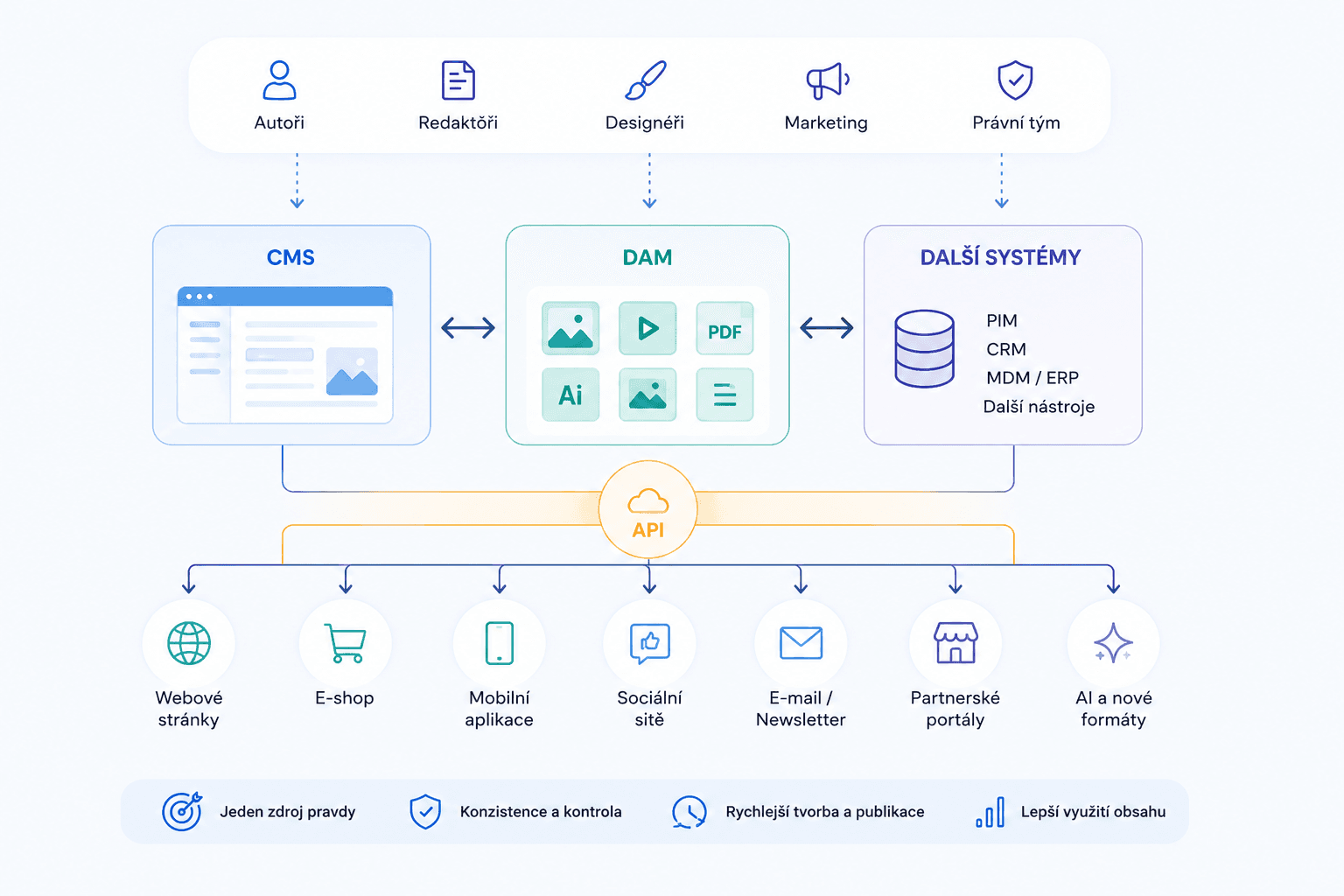
A copywriter creates the campaign copy in the CMS. A designer uploads product images and banners to the DAM. Product specifications are retrieved from the PIM, while customer data may come from the CRM. Because all these systems are connected, the required information flows automatically between them before being published to the company website, online store, newsletter, and social media channels.
Each system focuses on its own area of responsibility. The CMS doesn't manage images, the DAM doesn't publish web pages, and the PIM doesn't create articles. Together, however, they form a connected ecosystem that enables efficient content management without unnecessary file duplication or manual updates.
This is exactly the principle illustrated in the Content Infrastructure diagram.
How CMS and DAM Work Together
Although CMS and DAM are both essential parts of the same infrastructure, they serve different purposes.
A CMS manages textual content and publishing workflows. A DAM, on the other hand, manages digital assets and ensures that approved, up-to-date files are always available to the right people.
When the two systems are integrated, editors can insert images directly from the DAM while creating content in the CMS. If a designer updates an image, the latest version is automatically reflected wherever that asset is used.
BrandCloud enables organizations to centralize the management of digital assets and integrate them with other business systems. As a result, it becomes an important component of a modern Content Infrastructure, helping teams maintain consistent content across every channel.
Why Content Infrastructure Matters More Than Ever
As organizations continue to digitize their operations, the number of tools they rely on continues to grow. Content is no longer published only on websites—it also powers e-commerce platforms, mobile applications, customer portals, digital signage, and AI-powered solutions.
Each of these channels depends on the same content, product information, and digital assets. Without connected systems, organizations quickly face duplicate content, outdated files, and inconsistent information across channels.
This is why more companies are investing in Content Infrastructure. It is about much more than organizing content. It creates an environment that supports automation, improves collaboration across teams, and prepares organizations for the continued evolution of digital experiences and artificial intelligence.

Building a Foundation That Grows With Your Business
Content Infrastructure is neither a new software category nor a one-time project. It is a strategic approach to connecting content, technology, and workflows into a unified system.
As organizations expand the number of channels through which they communicate, a well-designed infrastructure becomes increasingly valuable. Connecting CMS, DAM, and other business systems simplifies content management, reduces duplication, and ensures every team works with the same accurate and up-to-date information.
For this reason, Content Infrastructure has become one of the core foundations of modern content management. Organizations that begin building it today will be better prepared for new technologies, automation, and the growing demands of digital communication.