Digital content is being created faster today than ever before. Marketing teams work with presentations, banners, videos, documents, and social media materials almost continuously. At the same time, the number of people working with these materials keeps growing. External agencies, freelancers, sales departments, and AI tools are all becoming part of the communication process. And this is exactly the moment when standard file storage starts to become insufficient.
The term digital asset has also become increasingly common in recent years. However, it is still often confused with an ordinary digital file. In reality, it represents a much broader concept. A digital asset is content that carries a certain value for a brand, communication, or company operations and is intended for further use.
And this is where asset management starts to become important.
What Is a Digital Asset
A digital asset is typically defined as digital content that has a certain value for a company and is used in marketing, communication, sales, or internal processes. It is therefore not just about the file itself, but also about its purpose, management, and long-term usability.
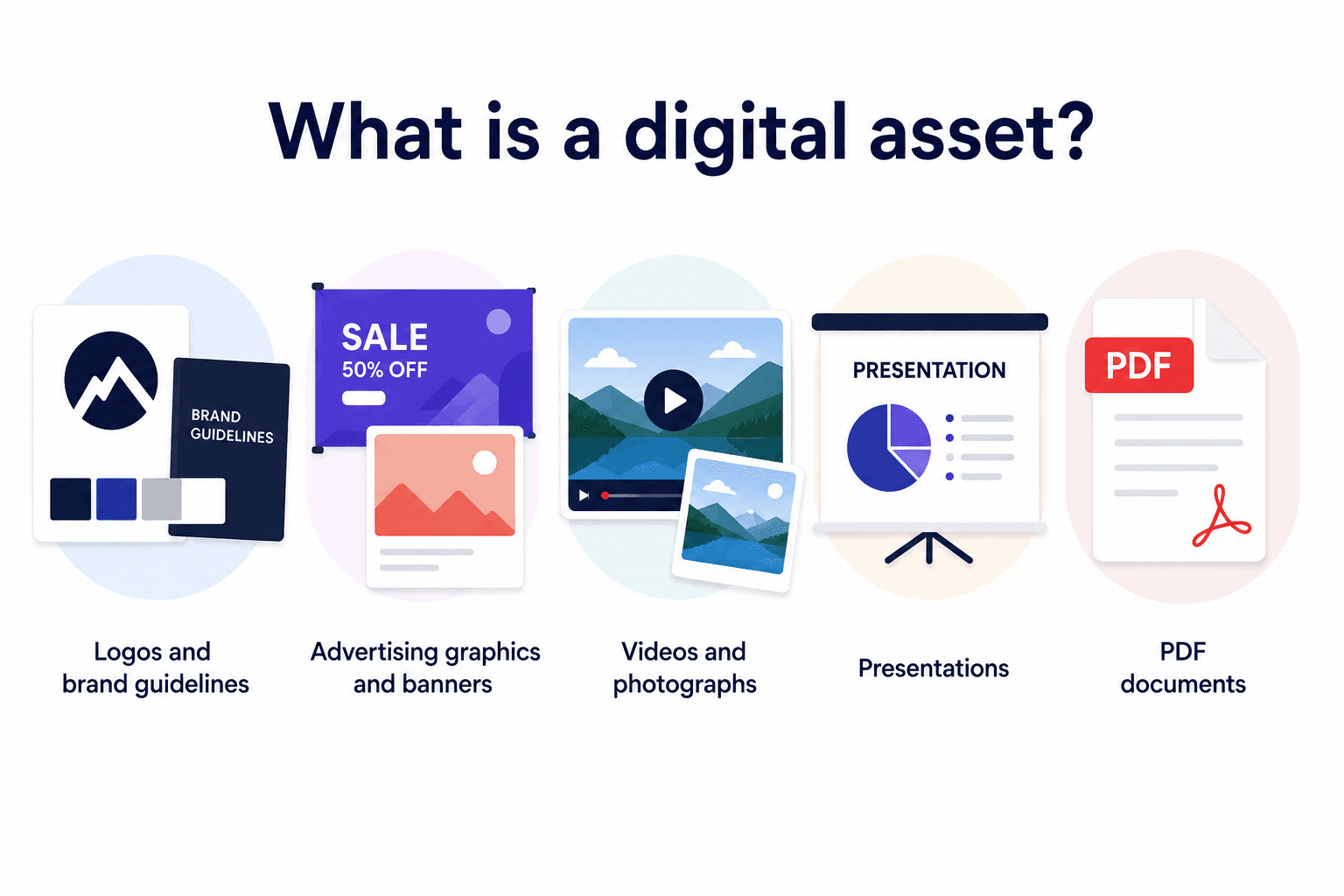
Digital assets most commonly include:
- logos and brand guidelines,
- advertising graphics and banners,
- videos and photographs,
- presentations,
- PDF documents,
- social media templates,
- UX or UI materials,
- onboarding materials,
- audio content.
The file format itself is usually not the deciding factor. More important is how the content is used within the company and how it connects to other processes. An asset is not just stored data. It is content designed for long-term use and management.
That is the fundamental difference.
A digital asset is also connected to specific value, version history, sharing capabilities, or defined usage rules. Considerable attention is often devoted to content creation, while less focus is placed on how materials will be organized, shared, or updated over a longer period of time.
When a File Becomes an Asset
Not every digital file automatically becomes an asset. The difference usually becomes visible once the content starts being used across teams, edited in multiple versions, or shared within broader brand communication.
An ordinary image stored on a computer does not necessarily have the value of an asset. The moment it becomes part of marketing materials, approval processes, or internal systems, its management suddenly becomes much more important.
As the amount of content grows, the number of versions, edits, and distributed materials increases as well. If the materials are not systematically organized, duplicates, outdated files, and confusion around current versions start appearing very quickly.
And this is exactly when it becomes clear that a digital asset is not just a file stored in a folder.
It becomes part of how a company operates.
Why Companies Are Focusing on Asset Management
The volume of digital content has increased significantly in recent years. Brand communication has accelerated as well. Content is continuously created for social media, advertising systems, e-commerce, newsletters, and internal communication.
This also brings a growing need for asset organization.
It is increasingly evident that the biggest issues do not arise during content creation itself, but during content search, sharing, or updates. If assets are not centralized and systematically managed, work becomes noticeably slower and communication less consistent.
Very quickly, different teams start working with different versions of materials, while content becomes scattered across multiple disconnected systems. The result is an environment that becomes difficult to navigate.
And content chaos is often far more expensive than expected.
This is exactly why asset management is becoming an increasingly important part of company operations. It is not just about organizing files. It is about maintaining control over the content a company uses every day.

What Digital Asset Management Should Look Like
Digital asset management today affects far more than just marketing. Asset management systems are also used in HR, sales, internal communication, and customer support. The more digital content a company creates, the more important it becomes to have a system that enables long-term content management.
Well-structured asset management should enable fast content search, version management, access control, and simple sharing of materials across teams. At the same time, increasing attention is being paid to metadata, tagging, and content centralization.
Brand consistency is also receiving significant attention today. If employees or external partners work with outdated materials, brand communication quickly becomes inconsistent and difficult to control.
BrandCloud enables companies to centralize digital assets into one environment, manage versions, and control the availability of materials across teams. And today, centralization represents one of the biggest differences between ordinary cloud storage and professional asset management.
Companies currently invest enormous amounts of time into content creation, while less attention is devoted to how assets will be used in the future. Yet the organization of digital content is increasingly affecting work speed, communication consistency, and overall team efficiency.
And the more content continues to be created, the more important it will become to keep that content under control.