
A company can have a DAM system in place and still manage its digital assets chaotically. Technology alone does not guarantee high-quality metadata, clear responsibilities, or well-defined processes.
This is exactly what the DAM maturity model helps to assess. In this context, maturity refers to how developed and sophisticated an organization’s approach to digital asset management is. The model helps determine where an organization currently stands and what it should improve next.
What does DAM maturity assess?
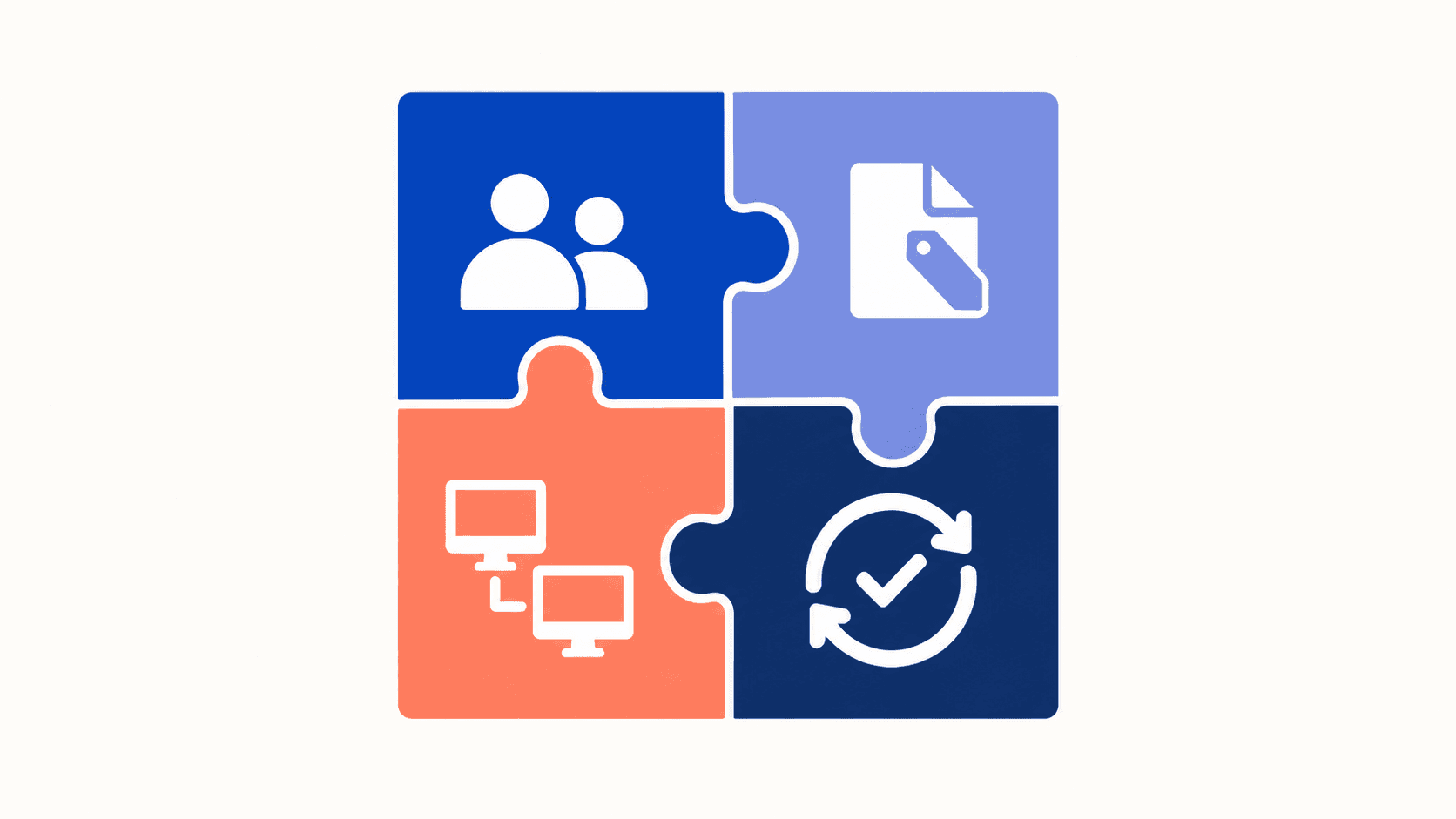
DAM maturity is not the same as simply having a DAM system in place. One of the original maturity models evaluates four core areas:
- People – who works with digital assets and who is responsible for them.
- Information – how assets are described, organized, and made discoverable.
- Systems – which technologies the organization uses and how they are connected.
- Processes – how content is created, approved, distributed, and archived.
A company may therefore have a modern DAM system, but if teams bypass it, metadata is inconsistent, and content remains scattered across other storage locations, its DAM maturity will still be low.
Five levels of DAM maturity
DAM maturity models vary in the number and names of their stages. The underlying principle is similar: organizations gradually move from scattered files and fragmented workflows toward systematic and partially automated content management.
1. Chaos
Assets are scattered across cloud storage, emails, employees’ computers, and external partners.
Typical signs include:
- no one is quite sure which version is current,
- duplicate files are common,
- finding an asset depends on specific people knowing where it is,
- there are no consistent rules for managing content.
The first step is to understand which assets the company has, where they are stored, and who uses them.
2. Centralization
Important assets are moved into a single environment, and the organization begins establishing rules for how they should be managed.
This is where metadata becomes important. Metadata describes content using information such as product, campaign, language, or approval status.
Typical signs: a central asset library, metadata and tags, basic permissions, and the gradual removal of duplicates and outdated versions.
3. Collaboration
More teams and external partners begin using the DAM. This makes DAM governance increasingly important – the rules and responsibilities that define how assets should be managed.
Roles, access permissions, and approval processes are clearly defined. It is also clear who is responsible for content, metadata, and archiving.
At this stage, DAM evolves from a file library into a shared working environment.
4. Integration
The DAM becomes connected to other tools, such as a CMS or e-commerce platform. Content no longer needs to be manually downloaded and uploaded every time it is used elsewhere.
The DAM acts as a central source of approved assets that other systems and channels can access.
This level becomes increasingly important as the volume of content, products, markets, and distribution channels grows.
5. Optimization
The organization continuously evaluates how its DAM is being used and looks for opportunities to simplify and automate processes.
AI can also support automatic tagging, content description, or search. Advanced technology alone, however, does not guarantee high DAM maturity. Without high-quality metadata and clear rules, automation can simply accelerate poorly designed processes.
How to determine your DAM maturity level
An organization does not have to fit neatly into a single level. It may have excellent metadata but no integrations, for example. Marketing may use the DAM systematically while the sales team still shares presentations via email.
It is therefore useful to ask a few simple questions:
- Can people find the right asset quickly?
- Can they identify the current, approved version?
- Do they know whether they are allowed to use it?
- Is it clear who is responsible for the content?
- Do all relevant teams use the DAM?
- How much work still involves manually searching for and sharing files?
The answers can provide a more useful picture than trying to assign the entire organization a single maturity score.
How to improve DAM maturity
Reaching the highest level does not have to be the goal. What matters is solving the problems that currently make digital asset management more difficult.
- Map your current situation. Find out where your assets are stored and how they are being used.
- Define metadata and rules. Content should be easy to find and managed consistently.
- Assign responsibilities. Make it clear who manages content, permissions, and archiving.
- Monitor DAM adoption. If people are bypassing the system, find out why.
- Automate gradually. Fix the process first, then automate it.
Progress can be measured by factors such as the time required to find an asset, the number of duplicate files, or the number of manual steps involved in distributing content.
How BrandCloud supports higher DAM maturity
BrandCloud helps move digital asset management from fragmented storage locations into a single, controlled environment.
It supports several areas associated with higher DAM maturity:
- centralizing digital assets,
- organizing assets with metadata and tags,
- managing access permissions,
- sharing approved content,
- using AI tagging to automate asset descriptions.
BrandCloud can therefore provide the technological foundation for a more systematic approach to digital content management. Technology, however, is only one part of the equation. High DAM maturity also requires clear rules, defined responsibilities, and processes that people actually follow.
A mature DAM does not have to be the most complex
The DAM maturity model shifts the question from “Do we have a DAM?” to something far more useful: “How well do we manage our digital assets?”
A mature approach means that people can quickly find the right asset, identify its current version, and know whether they are allowed to use it. This does not necessarily require the most complex technological solution.
The purpose of a maturity model is therefore not to push every organization toward the highest possible level. It is to understand where you are today and identify the next step that will genuinely improve the way you manage digital assets.