
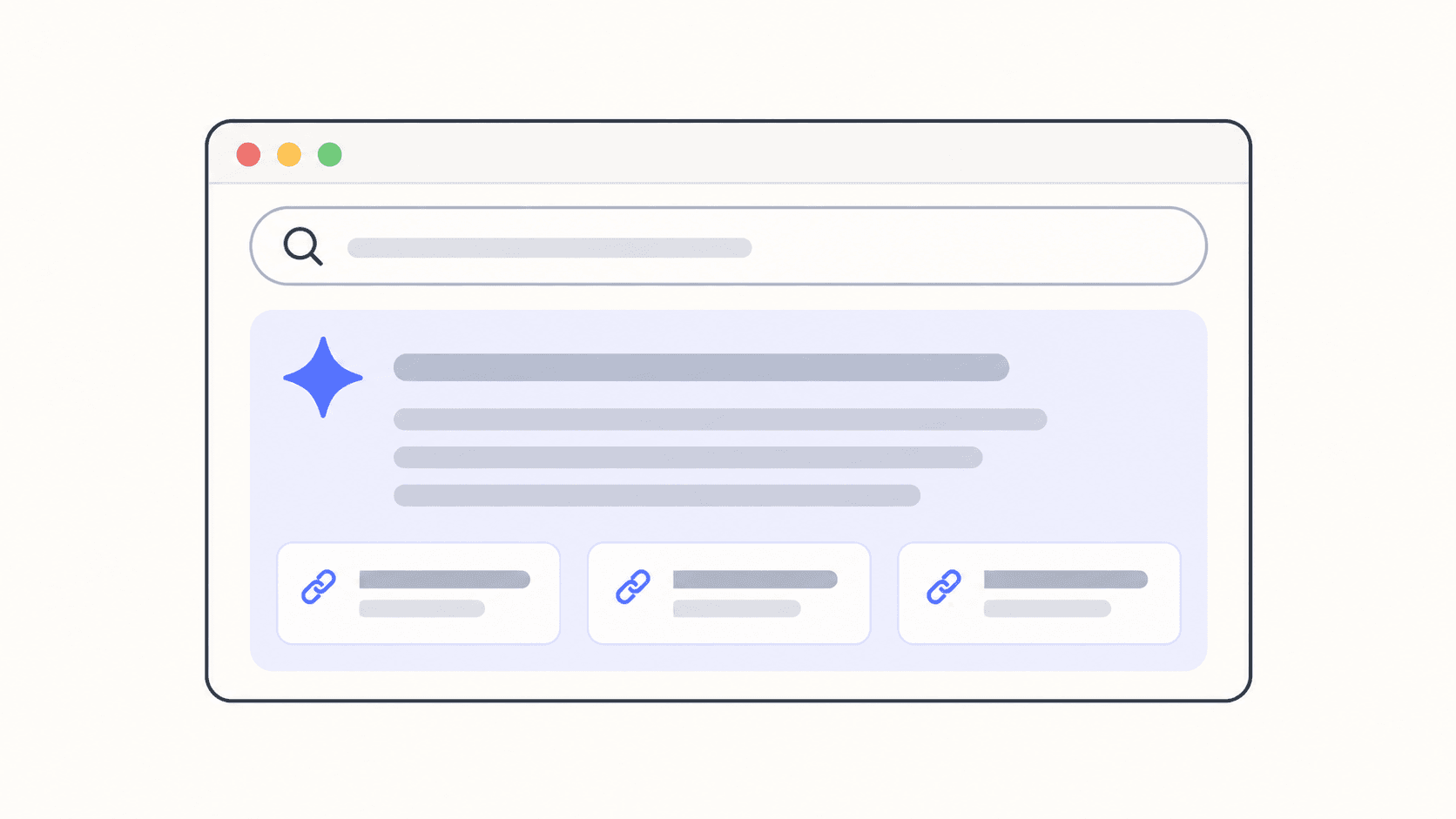
AI-powered search is changing how people find information. Alongside a list of links, they can receive a direct answer compiled from multiple sources. A company’s content can therefore play a role even before someone visits its website.
This is where GEO, or Generative Engine Optimization, comes in. It builds on SEO and broadens the focus to include whether AI uses, cites, and correctly interprets content.
GEO vs. SEO: Key Differences
SEO (Search Engine Optimization) helps search engines find a page, understand its content, and present it to people searching for related information. The goal is to improve a website’s visibility in organic search results and attract relevant visitors.
SEO involves working with search terms, page titles, headings, and links. It also covers the website’s technical performance, accessibility, and the credibility of its content.

GEO (Generative Engine Optimization) focuses on increasing the likelihood that a generative system will use content when creating an answer or mention a brand within it.
The main difference lies in how results are presented and measured:
- Content placement – SEO tracks page rankings in search results, while GEO also considers their presence in AI-generated answers.
- How content is used – in traditional search, a link takes users to the original page, whereas AI may summarize its information directly in an answer.
- Measurement – citations, brand mentions, and the accuracy of brand descriptions join rankings, clicks, and traffic as metrics to track.
The two approaches overlap. Clear, technically accessible content that addresses the topic being searched for forms their shared foundation.
How to Prepare Content for AI Search
Preparation starts with understanding what information people are looking for and what they need to resolve. From an SEO perspective, a page should have a clearly defined topic, an appropriate title, and a clear structure. GEO adds an emphasis on how individual passages can be used within a generated answer.
Each section should therefore make sense on its own. It must be clear what it describes and under what conditions the information applies.
When refining content, it helps to:
- Incorporate search terms naturally. Titles, headings, and body text should use the terms people commonly use to describe the topic.
- Answer directly. Place the main explanation at the beginning of the relevant section, then add details.
- Structure the text clearly. Give each topic its own section with a descriptive heading.
- Preserve context. Clearly identify what the information refers to and state any conditions or limitations.
- Link related content. Links between pages make it easier to find details and navigate the topic.
The length of the text should reflect the complexity of the question. A brief definition can be part of a detailed article, provided the following paragraphs offer useful explanations.
What Supports Content Credibility and Accessibility
Well-organized text needs a factual foundation. Original measurements, documented workflows, professional experience, and case studies can all add value. Information drawn from other sources should be traceable to its origin.
Published results should clearly explain how they were obtained. Numerical data needs context, particularly the measurement method, timeframe, and conditions. Naming the author or the person responsible for expert review also supports credibility.
Technical accessibility is a separate consideration. Important information should be available as text, and the website’s settings must allow access by the relevant search systems. If content cannot be retrieved, changing the wording alone will not solve the problem.
Updates should correct outdated information and reflect actual changes. Simply changing the publication date does not increase an article’s informational value.
Why Up-to-Date Brand Materials Matter
Different descriptions of the same service across a website, presentations, and partner materials make the offering harder to understand. Updating a single page is therefore not enough. It is necessary to identify where the information is used and who is responsible for correcting it.
BrandCloud enables centralized management of digital assets, including photographs, logos, presentations, and other materials. It offers file sharing, permission settings, and version management. Teams can therefore work from shared, up-to-date materials.
For SEO and GEO, this supports consistent publishing. Managing brand materials helps reduce inconsistencies in the content a company subsequently publishes on its website and across other channels.
How to Evaluate the Value of GEO
A citation in an AI-generated answer and a website visit are two different outcomes. Similarly, a brand mention does not necessarily mean that its service is being recommended. Evaluation should therefore distinguish between:
- Visibility – whether the brand or its content appears in answers to relevant queries.
- Accuracy – whether the answer correctly describes the offering and its capabilities.
- Traffic – whether people click through from AI services to the website.
- Business impact – whether attributable visits lead to inquiries, sign-ups, or purchases.
Results may vary across tools and individual queries. A higher number of citations does not, on its own, demonstrate higher sales. Tracking results over time and comparing the same set of questions is more meaningful than drawing conclusions from a single answer.
Monitoring traditional SEO results remains important as well. Page rankings, clicks, and traffic show how content performs in traditional search. AI visibility data complements this perspective.
Quality Content as a Shared Foundation
GEO extends content work to include its use in AI-generated answers. A sensible starting point is to review important pages, remove ambiguities, and add the information people need to make decisions. Adding an FAQ or more bullet points does not, by itself, guarantee a citation.