
Artificial intelligence has become a powerful marketing argument in just a few years. The term AI appears in products, services, and internal processes of companies across all industries. At the same time, however, there is growing talk of AI washing, a situation where artificial intelligence is presented as part of a solution even though its use is minimal, inaccurate, or completely absent.
For brands, this is not a minor inaccuracy in communication. It is a reputational risk that can affect relationships with customers, investors, and employees. At a time when trust in technological claims is sensitive and regulations are stricter, transparent communication is becoming a prerequisite for long-term brand stability.
What is AI washing and why does it happen?
AI washing refers to the practice of organizations exaggerating or distorting the extent to which artificial intelligence is used in their products and services. This may involve marketing claims that create the impression of advanced algorithms, even though they are actually standard automation, statistical models, or manual processes.
This kind of behavior isn't new in the history of technology. Every major innovation, from electricity to the internet to the cloud, has been accompanied by fears and exaggerated expectations. Fear of new technologies comes back regularly, as does the tendency for companies to jump on the latest bandwagon at any cost. Artificial intelligence is now a symbol of progress, efficiency, and modernity, making it a powerful marketing tool.
The problem arises when communication outpaces reality. If a brand claims that its product uses AI, but in reality it is just simple rule-based scripts, there is a discrepancy between expectation and reality. And it is this discrepancy that is the basis of reputational risk.
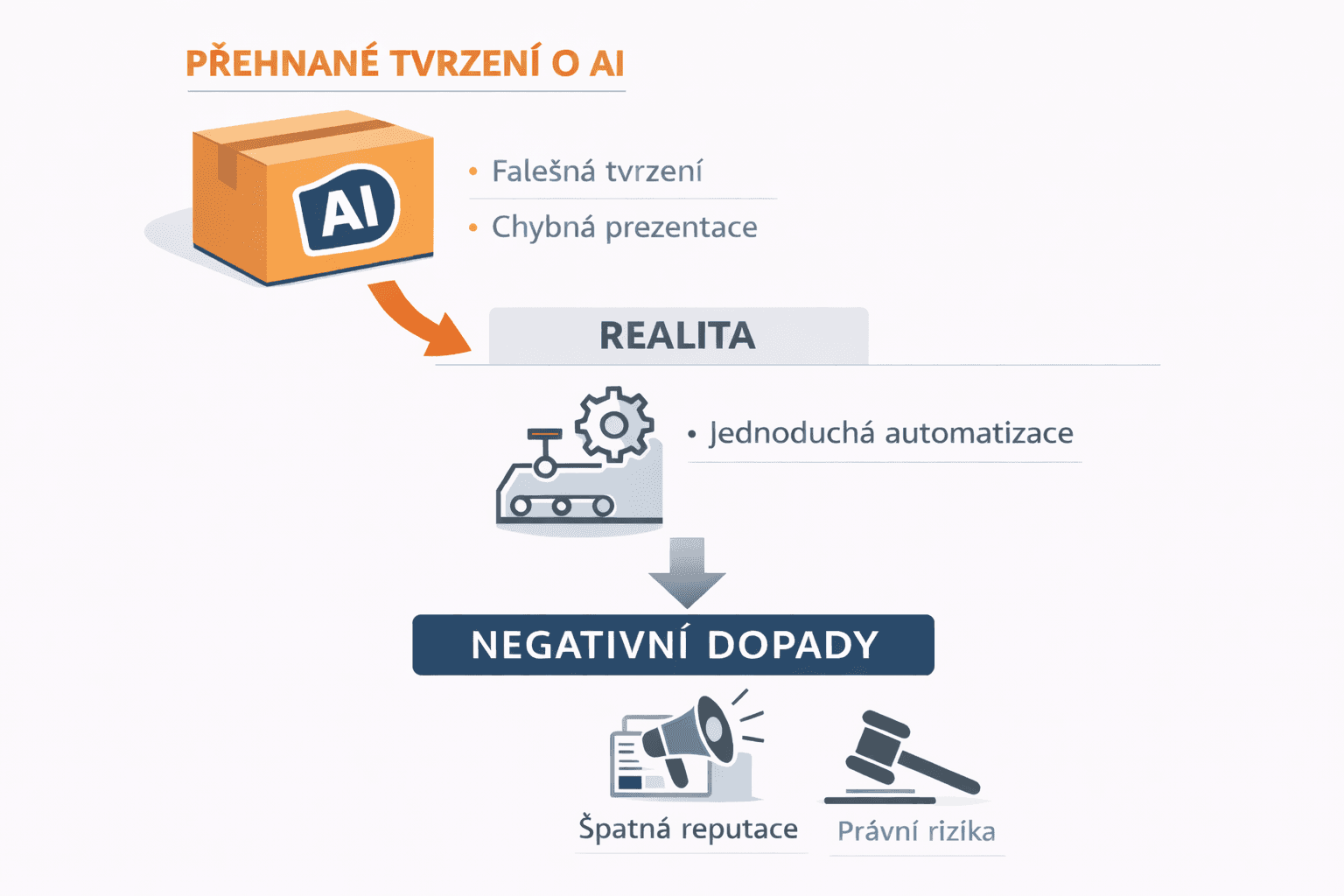
AI washing as a reputational and legal risk
Why is AI washing a threat to brand reputation? Primarily because it undermines trust. Trust is long-term capital that is built gradually but can be lost very quickly.
If a customer discovers that they have been misled, they react more sensitively than in the case of normal marketing simplification. This is because technology is expected to be professional, accurate, and fair.
The regulatory environment is also becoming stricter. Supervisory authorities and legal frameworks are increasingly focusing on whether companies are providing truthful information about their use of artificial intelligence. Misleading statements may be considered false advertising or a breach of obligations to investors. There are cases abroad where companies face criticism or investigation for exaggerated claims about AI.
The reputational impact often precedes legal action. The media and the public react sensitively, for example, to situations where AI is presented as the reason for layoffs, even though the real reasons are more complex. Such communication can damage the brand's image as a responsible employer.
The most common reputational impacts of AI washing can be summarized as follows:
- Casting doubt on the credibility of the brand and weakening its authority in the eyes of customers
- Reduced loyalty among customers who expected a higher level of technological service
- Risk of negative media attention, which can quickly escalate on social media
- Tension within the organization if employees perceive a difference between internal reality and public communication
How AI washing affects brand perception
A brand is the sum of experiences, expectations, and emotions that people associate with it. If a company communicates that it uses advanced artificial intelligence, customers form an idea of higher quality, efficiency, or personalization.
When this perception is not fulfilled, reputational dissonance occurs, i.e., a discrepancy between promise and reality. In the long term, this can lead to the questioning of other brand messages.
AI washing is therefore not an isolated problem for a single product. It can weaken the overall position of the brand in the market, affect customer loyalty, and reduce investors' willingness to trust the company's strategic plans.
The question every organization should ask itself is: If we had to explain in detail how our AI works, would our claims stand up to scrutiny by both experts and the general public?

Transparent communication as prevention
How to avoid AI washing? The key is accuracy and clarity. If you use machine learning, it is advisable to briefly explain that it is a method in which the system learns from data and gradually improves its predictions. When it comes to automation based on predefined rules, it is fair to admit this openly.
Transparent communication does not mean revealing trade secrets. It means describing the technology in a way that corresponds to reality and does not create unrealistic expectations.
In practice, this is also related to internal content and version management. If marketing teams work with different presentations, web texts, and sales documents, it is important to have an overview of how AI is described in each channel.
This is where systematic management of digital materials can help. Brandcloud allows you to centralize approved versions of documents and ensure that communication across teams remains consistent. This reduces the risk of inaccurate or exaggerated claims about the use of artificial intelligence entering circulation.
Trust as the foundation of technological communication
Artificial intelligence undoubtedly brings new possibilities. It increases efficiency, enables better data analysis, and supports the personalization of services. This means that brands have an even greater responsibility when presenting it.
The short-term marketing effect may seem appealing. In the long run, however, credibility is what matters. Customers, investors, and employees expect claims about AI to be backed up by real-world use of the technology.
AI washing is therefore a warning that communication about technology must be accurate, appropriate, and ethically grounded. Brands that can openly explain where and how they use artificial intelligence and where they do not use it strengthen their reputation and stability for the future.
In an environment of rapid technological development, it may seem necessary to keep up at all costs. However, a strong brand is not built on exaggeration, but on trust. And trust is built primarily through truthful communication.