
The way brands communicate and build their identity has been gradually changing in recent years. The focus is shifting away from products and visual presentation toward people, their needs, and their experiences. This is where the concept of human-centric branding emerges, referring to an approach that places people at the center.
This shift responds to an environment in which customers make decisions differently than before. They expect clear communication, a consistent experience across channels, and brands that feel authentic. Human-centric branding therefore represents more than just a change in marketing—it reflects a broader transformation in how organizations think about their role and their relationship with people.
What human-centric branding means
Human-centric branding can be understood as an approach to building a brand based on a deeper understanding of people. It is not only about identifying who the customer is, but also about understanding how people think, how they make decisions, and what they expect from a brand.
Unlike traditional models that focused primarily on the product and its features, attention shifts toward the overall brand experience. This includes not only the purchase itself, but also communication, visual identity, accessibility of information, and the way a brand responds to user needs.
A key element of this approach is empathy—the ability to understand another person’s situation. Brands aim to recognize the contexts in which their audiences operate and adapt their outputs accordingly. The result is communication that feels more natural and easier to understand.
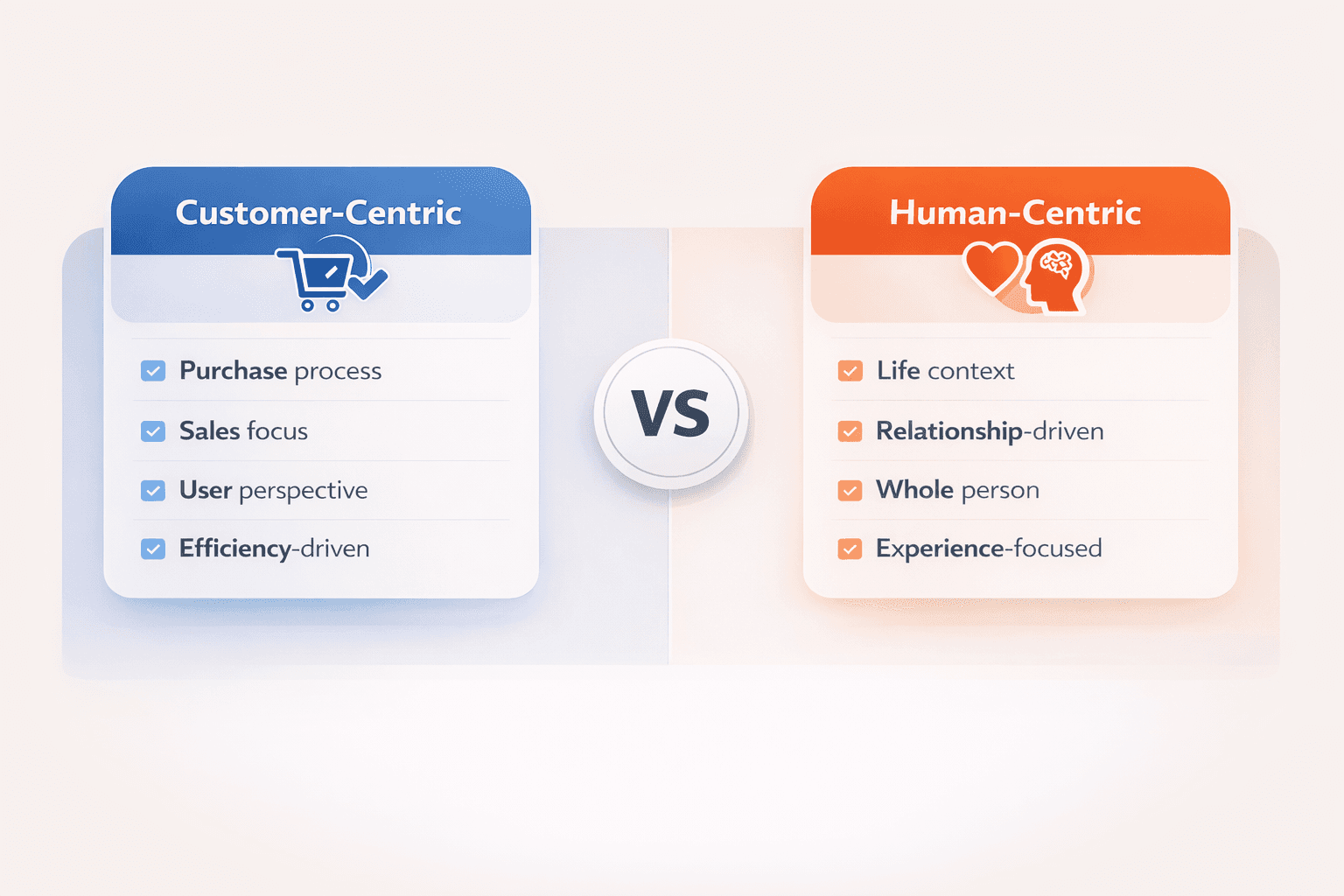
The difference between human-centric and customer-centric approaches
At first glance, human-centric branding may seem identical to the concept of a customer-centric approach, meaning a focus on the customer. However, there is a significant difference between the two.
A customer-centric approach primarily focuses on the customer as a user of a product or service. It examines their needs in relation to the purchase process and seeks to optimize touchpoints to make the process as efficient as possible.
Human-centric branding goes a step further. It does not view the customer only as a role, but as a person as a whole. It takes into account broader aspects of their life, including values, emotions, and the circumstances in which decisions are made. This allows brands to build deeper and more long-term relationships.

How a human-centric approach influences design and communication
Human-centric branding significantly affects how a brand looks and communicates. Visual identity, tone of voice, and content structure are adapted to how people perceive and process information.
In design, this approach is grounded in human-centered design, which means designing with the user in mind. This implies that solutions are not based solely on aesthetics, but on real user behavior and needs.
This approach is typically reflected in:
- an emphasis on readability and clarity of visual materials,
- more intuitive content structure and information hierarchy,
- consistent visual identity across different channels,
- a natural and human tone of communication,
- responsiveness to user feedback.
These principles help create an environment where people can navigate more easily and build a stronger connection with the brand.
Why human-centric branding is gaining importance now
Today’s digital environment brings an overwhelming amount of stimuli that people need to process. In such conditions, brands that communicate clearly, simply, and with consideration for users gain more attention.
At the same time, expectations are evolving. People pay closer attention to how brands behave, how they handle information, and whether their communication aligns with reality. Trust and transparency are becoming important factors in decision-making.
Human-centric branding responds to this development by connecting strategy, design, and communication into a cohesive whole. The brand no longer appears as a set of isolated elements, but as a consistent system that makes sense from the user’s perspective.
How to apply this approach in practice
Implementing human-centric branding is not a one-time change, but a gradual shift across the entire organization. It begins with understanding who the people are that the brand communicates with and what they need.
It is important to work with data and feedback, while also interpreting them in a broader context. Numbers alone are not enough—it is necessary to understand the story behind them.
In practice, this approach is reflected in content creation, digital product design, and the management of visual assets. This is where tools that support consistency and organization become particularly valuable.
BrandCloud helps organize digital assets so they are easily accessible and aligned with the current state of the brand. This allows teams to work with unified materials and ensures that communication remains clear and consistent across all channels.