Digital products were designed for a long time primarily with an emphasis on functionality, clarity, and ease of use. Attention was focused mainly on ensuring that users could quickly complete a specific task and easily navigate the interface. It was precisely from this approach that the term UX, or User Experience, emerged and gradually became the standard of modern digital design.
However, with the growing development of artificial intelligence, it is becoming apparent that traditional UX is no longer sufficient in many cases. Today, digital products increasingly function not only as static interfaces, but as intelligent systems capable of responding to context, communicating with users, and continuously adapting to their needs.
As a result, AX, or AI or Agentic Experience Design, is moving to the forefront.
Designing an interface is no longer enough.
The behavior of the system must also be designed.
What UX Represents
UX, or User Experience, refers to the user’s experience while using a digital product, website, or application. Within UX, attention is focused primarily on usability, intuitive navigation, content clarity, and the efficiency of individual interactions.
The goal is usually to create an environment in which required tasks can be performed easily and without unnecessary complications. Emphasis is placed, for example, on logical layouts of elements, responsiveness for mobile devices, or the simplification of user processes.
For a long time, UX was based primarily on working with visual interfaces. Screens, buttons, navigation systems, and individual user journeys were designed. Products were expected to be fast, efficient, and easy to understand.
Over time, however, digital interfaces began to become increasingly unified. Modern applications often use similar design systems and comparable navigation principles. Usability alone is therefore no longer a sufficient factor for differentiating digital products.

AX Is Changing the Way Digital Products Are Designed
AX, or AI or Agentic Experience Design, represents an approach focused on designing experiences during interactions with intelligent systems. Attention is no longer focused solely on the visual interface, but also on the way the system communicates, its behavior, transparency, and its ability to respond to context.
Within AX, systems are designed to appear understandable, trustworthy, and natural. What matters is not only the functionality of the AI model, but also the way users understand its decision-making and how they are able to collaborate with it.
AX is therefore focused primarily on:
- designing communication between humans and AI systems
- transparency and explainability of responses
- maintaining user control and agency
- working with context and long-term system memory
- ethical and inclusive design of AI interactions
The fundamental difference compared to traditional UX lies in the fact that intelligent systems do not respond the same way every time. Responses change depending on context, previous communication, or the way prompts are formulated. As a result, not only the interface is being designed, but also the behavior of the system itself.
UX focuses on using the product.
AX focuses on collaboration between humans and intelligent systems.
AI Products Require a New Approach
In the environment of artificial intelligence, traditional linear user scenarios are no longer sufficient. AI systems communicate dynamically, react to different situations, and continuously work with context. It is therefore necessary to account for different types of responses, ambiguous inputs, and unexpected system behavior.
A strong emphasis is also beginning to be placed on trust and transparency. Users must understand why AI performed a specific action or on what basis a particular response was generated. If the system appears unpredictable or non-transparent, trust can be weakened very quickly.
An important part of AX therefore becomes:
- explaining system decisions
- the ability to modify or correct outputs
- designing natural conversational scenarios
- working with user feedback
- maintaining control over AI behavior
The work of designers is also changing significantly. In addition to traditional UX competencies, areas such as conversational design, prompt design for language models, or working with contextual memory systems are becoming increasingly important.
It is no longer only screens that are being designed.
Behavior is being designed.
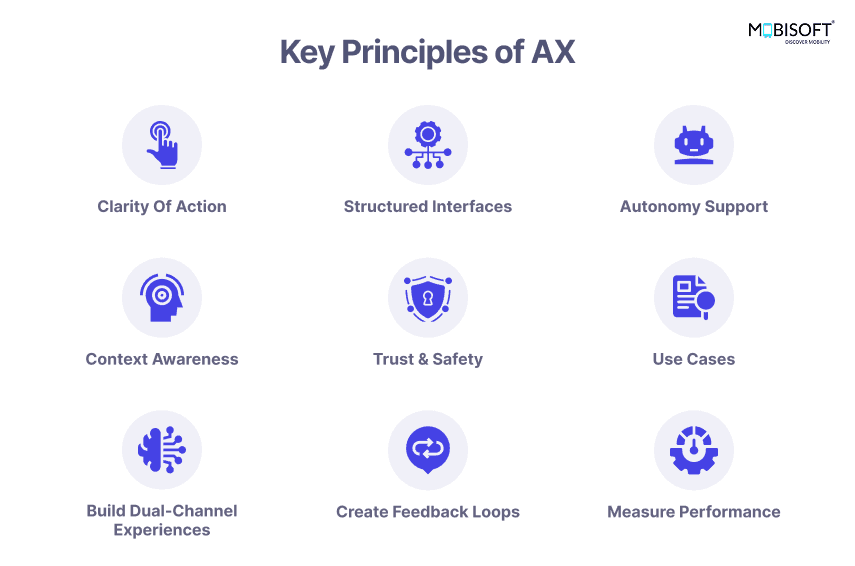
Source: Mobisoft
Why AX Is Moving to the Forefront Right Now
The growing importance of AX is mainly connected to the massive rise of generative artificial intelligence. AI assistants, chatbots, and intelligent agents are becoming a common part of digital products and are increasingly influencing users’ everyday work.
Digital products are no longer functioning solely as tools for completing specific tasks. They are becoming active partners in working with information, content creation, or decision-making. For this reason, it is no longer sufficient to focus only on interface speed or visual clarity.
The trustworthiness of the system, the way it communicates, and the ability of AI to respond naturally and understandably are becoming equally important.
As the complexity of digital products increases, the importance of communication consistency and brand management is also growing. BrandCloud enables centralized management of digital assets, brand manuals, and resource sharing across teams. In the AX environment, communication consistency is essential because user experience is no longer created solely by the visual interface, but also by tone of voice, content, and system behavior.
UX still remains an important part of digital product design. However, usability alone is often no longer sufficient in AI system environments. Increasing emphasis is being placed on transparency, trust, communication, and the ability to create natural collaboration between humans and technology.