Artificial intelligence has become a standard part of graphic design tools over the past two years. Tasks that until recently required the expertise of professional designers can now be completed by almost anyone using just a few text prompts.
Google is therefore not entering an entirely new market. Instead, it is responding to the growing demand for faster visual content creation while expanding the capabilities of Google Workspace, a platform used by millions of businesses worldwide.
Google Pics is powered by Google's Nano Banana image model and focuses on both image generation and editing. Rather than introducing just another AI image generator, Google's goal is to create an environment where users can produce and edit graphics without switching between multiple applications.
Google has announced that Google Pics will begin rolling out to Google Workspace customers in mid-August 2026. The initial release will be available to business and education accounts.
Google Pics focuses on simple image editing
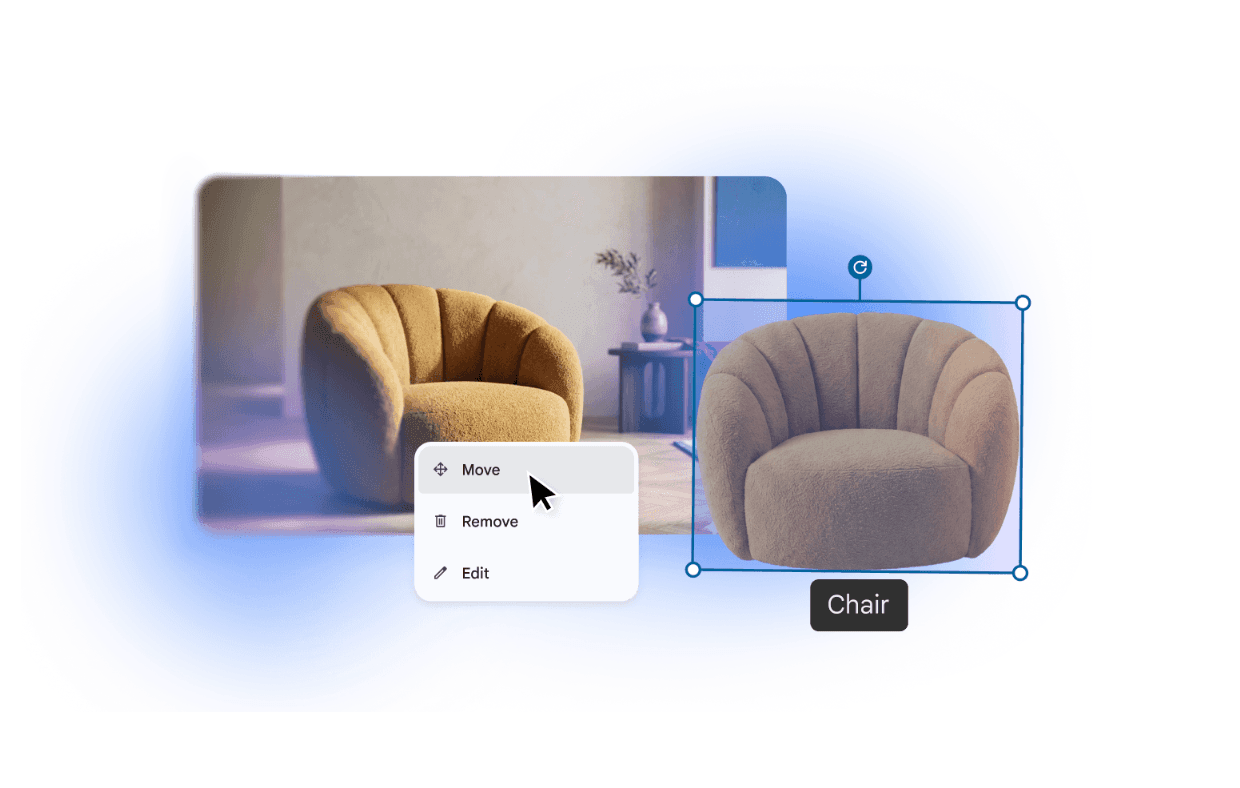
The core idea behind Google Pics is to make image editing as simple as possible using natural language. Users do not need advanced design skills or complex prompts. Instead, they can simply select a specific part of an image and describe the desired change.
Key capabilities of Google Pics include:
- generating images from text prompts,
- editing selected parts of an image without creating a new prompt,
- modifying objects, colors, text, or backgrounds,
- creating multiple variations of a design,
- seamless integration with Google Workspace applications.
The ability to edit individual elements of an image closely resembles working in a traditional graphic editor. Instead of generating a new image every time a change is needed, users can simply refine the existing one.
Source: Google
Competition is strong, but Google is taking a different approach
Google is entering a market that is already highly competitive. Several well-established platforms already offer AI-powered creative features.
Among the most notable are:
- Canva, which offers AI image generation, Magic Edit, and Magic Grab for object manipulation.
- Adobe Express, which uses Adobe Firefly's generative AI for marketing content creation and quick photo editing.
- Microsoft Designer, which combines AI image generation with the creation of social media posts, presentations, and marketing materials.
For Google, AI capabilities alone are not the main differentiator. The real advantage of Google Pics lies in its deep integration with the Google Workspace ecosystem.
Integration with Google Workspace is the real game changer
Most graphic editors operate as standalone applications. Users create an image, download it, and then insert it into a presentation, document, or another platform.
Google is taking a different approach. Google Pics will be available directly within Google Workspace.
It will integrate with applications such as:
- Google Docs,
- Google Slides,
- Google Sheets,
- the standalone Google Pics web application.
This means that a marketing specialist can create an illustration while working on a presentation, edit it instantly, and use it immediately without exporting files or switching between multiple applications.
For many organizations, this seamless workflow may prove to be an even greater advantage than the AI features themselves.
AI speeds up content creation, but it doesn't organize your assets
Google Pics has the potential to dramatically accelerate the creation of visual content. As generating graphics becomes easier, companies will inevitably produce a much larger volume of creative assets.
However, speed is only part of the equation. While AI can generate visuals in seconds, it does not automatically understand a company's brand guidelines. It may use incorrect brand colors, unsupported fonts, an outdated logo, or a visual style that doesn't match the company's identity. As a result, AI-generated designs often require review and refinement before they are ready for use.
AI image editors also do not solve another important challenge: asset management. They cannot determine which version of a logo is the latest, where approved images are stored, or whether employees are using the correct marketing materials. In larger organizations, hundreds of new files can be created within a short period of time, making it increasingly difficult to maintain consistency.
This is why Digital Asset Management (DAM) systems are becoming more important alongside AI-powered design tools. BrandCloud provides a centralized platform for managing photos, logos, graphic assets, templates, and other brand materials. Teams always have access to approved files, making it easier to maintain a consistent visual identity across the entire organization.