
Canva has long been more than just a simple editor for presentations and social media posts. With the new Canva ProSuite, the company is taking a significant step further. It brings professional graphic design, motion design, data visualization, and generative AI together within a single ecosystem.
Canva is moving into territory that Adobe has dominated for years. But its approach is not based on copying Creative Cloud. Instead, it focuses on connecting professional tools with an environment where other team members can continue working with finished designs.
What is Canva ProSuite
Canva ProSuite consists of several specialized tools.
- Affinity – graphic design, vector graphics, photography, and layout
- Cavalry – motion design and animation
- Flourish – interactive data visualization
- Leonardo.Ai – AI powered visual content generation
What matters is how these tools work together. Graphics created in Affinity, for example, can be opened in Cavalry while preserving their layers. Data can come from Canva Sheets, and the resulting content can then move into Canva.
Canva ProSuite therefore covers several stages of the creative process without trying to squeeze every function into a single application.
Affinity makes it easier for Adobe users to switch
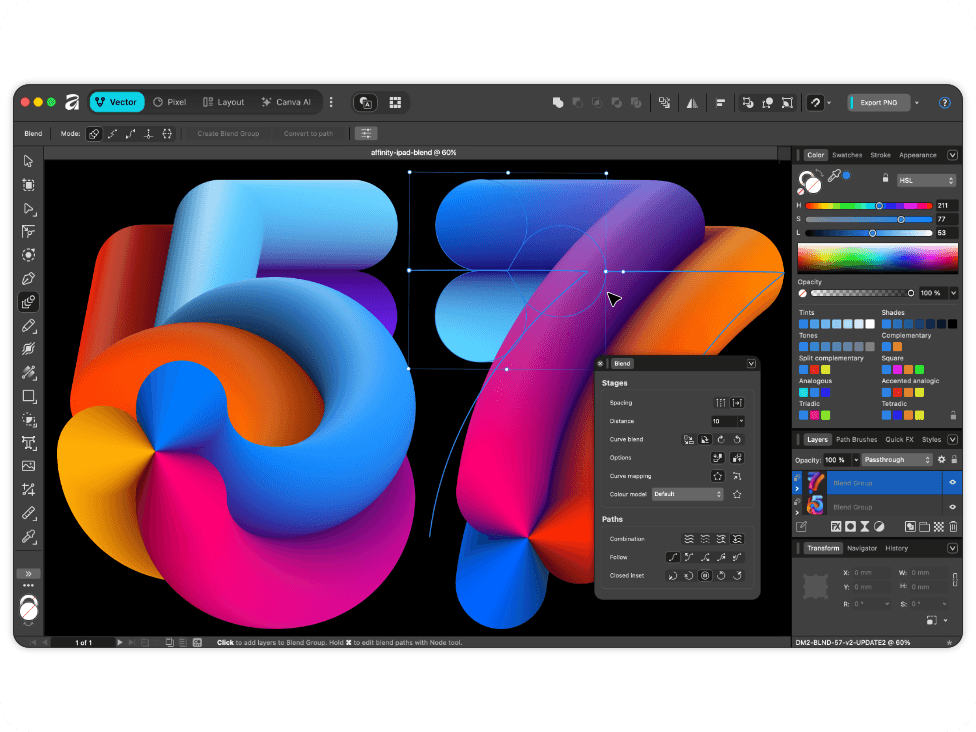
Affinity is a clear sign of Canva's professional ambitions. The update introduces the Blend Tool, easier mask editing, support for 3D models, and expanded RAW photo editing capabilities.
For Adobe users, however, native import of INDD files from Adobe InDesign may be even more interesting.
Features alone do not determine whether creatives are willing to switch software. Designers also need to continue working with older projects and client files. Direct import can therefore remove one of the practical barriers to moving to a different ecosystem.
Affinity also introduces automation through scripting and a Claude AI connector. Repetitive tasks can be described in natural language and automated, including batch edits and file preparation.
Canva also states that Affinity user content is not used to train these AI features and that files remain stored locally on the device.
Source: Canva
Cavalry brings an interesting approach to brand management
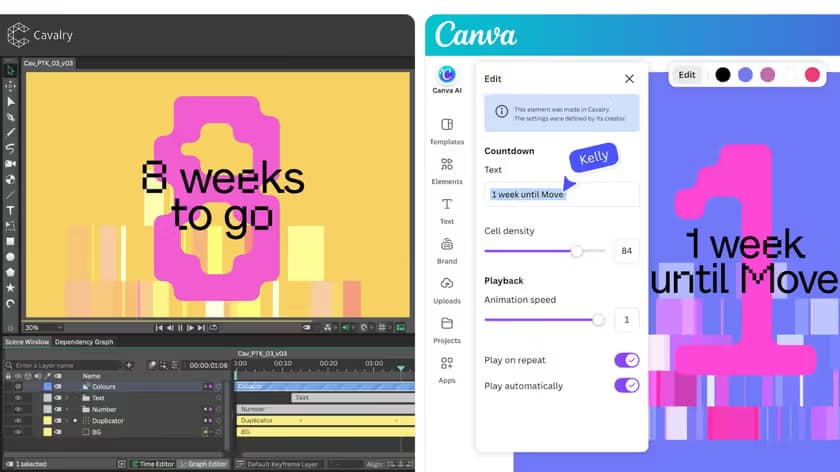
Motion design tool Cavalry offers an interesting option for marketing teams. A designer can create an animation and determine which parts other users are allowed to change.
The marketing team can then edit elements such as text, images, or colors, while the composition, motion, or logo usage remain locked.
An international campaign is a good example. A central team creates the main animation, while local teams change the language, price, or campaign date. They do not need to contact a designer for every small adjustment, while protected parts of the visual identity remain untouched.
Brand guidelines therefore do not have to exist solely as a document containing rules. Some restrictions can be built directly into the templates people use.
Source: Canva
How does Canva ProSuite compare with Adobe
Adobe still has a significant lead. Photoshop, Illustrator, InDesign, Premiere Pro, and After Effects are standards across many creative fields. Creative Cloud also benefits from long established workflows, plugins, and integrations.
Canva is approaching the market from the opposite direction. It started by making design accessible to a broad audience and is now moving towards professional users through Affinity, Cavalry, and its other products.
That is why simply asking whether Affinity can replace Photoshop or Cavalry can replace After Effects is not particularly useful. Canva ProSuite is not a replacement for Creative Cloud yet. It does, however, offer an alternative for teams looking to connect professional creative work with the subsequent production of marketing content.
More content creates greater demands for asset management
A single visual now routinely becomes multiple versions for social media, websites, advertising, different languages, or different markets. AI and automation can increase the number of these outputs even further.
As the volume of content grows, organizing it becomes increasingly important.
BrandCloud enables centralized digital asset management for photos, videos, logos, graphics, documents, and other content. Teams can work with approved materials and find their latest versions more easily.
Canva ProSuite primarily focuses on content creation and adaptation. BrandCloud takes care of its subsequent organization and management. This reduces the risk of faster production creating a growing collection of files that teams can no longer navigate effectively.
Pricing could be one of Canva's strongest advantages
The pricing model is also worth noting. Canva says that the core versions of Affinity and Cavalry will remain free. Some advanced AI and team features are connected to Canva's paid plans.
For a professional studio deeply invested in Adobe Creative Cloud, price alone may not be enough to justify switching. The situation may be different for freelancers, students, smaller teams, and creatives who are just starting out.
Canva therefore does not necessarily need to convince existing Adobe users to leave immediately. It can appeal to people who are still building their professional creative workflow.
What Canva ProSuite means for brands
Before switching tools, it makes sense to evaluate the entire content creation process.
- Separate creative work from routine adaptations – designers do not need to handle every text or format change themselves
- Automate repetitive tasks – focus on activities that do not require creative decision making
- Set boundaries for template editing – greater team independence should not compromise visual identity
- Check compatibility – the ability to import a file does not guarantee a flawless transfer of a complex project
- Think about asset management – a growing volume of content requires a clear system for organization and approval
Adobe has the lead, but Canva is gaining a new position
Canva ProSuite is not yet a replacement for Adobe Creative Cloud. Adobe offers deeper professional tools, established workflows, and a strong position across the creative industry.
The launch does, however, show that Canva no longer wants to appeal only to people looking for a simple online editor. Affinity, Cavalry, Flourish, and Leonardo.Ai are opening the door to more professional creative work.
Canva may therefore not pose an immediate threat to Adobe. But it is becoming a competitor that will be increasingly difficult to ignore.