
Today, digital products are created in an environment where clarity, quick orientation, and visual quality across devices are expected. Users have become accustomed to interfaces that are structured but not rigid. It is in this context that the term Bento Grid is increasingly appearing—a way of working with content that changes the traditional view of grids in design and offers a more flexible approach to organizing information.
Bento Grid is not a short-term trend. It is a response to the transformation of digital interfaces, where visual design, content, and user experience intertwine. In order to use this principle meaningfully, it is important to understand its origins, how it works, and its impact on contemporary design.
The principle of Bento Grid and its origins
Bento Grid is inspired by Japanese bento boxes, which divide food into separate compartments. Each part has a clearly defined space, purpose, and visual balance in relation to the others. The same principle is transferred to the digital environment.

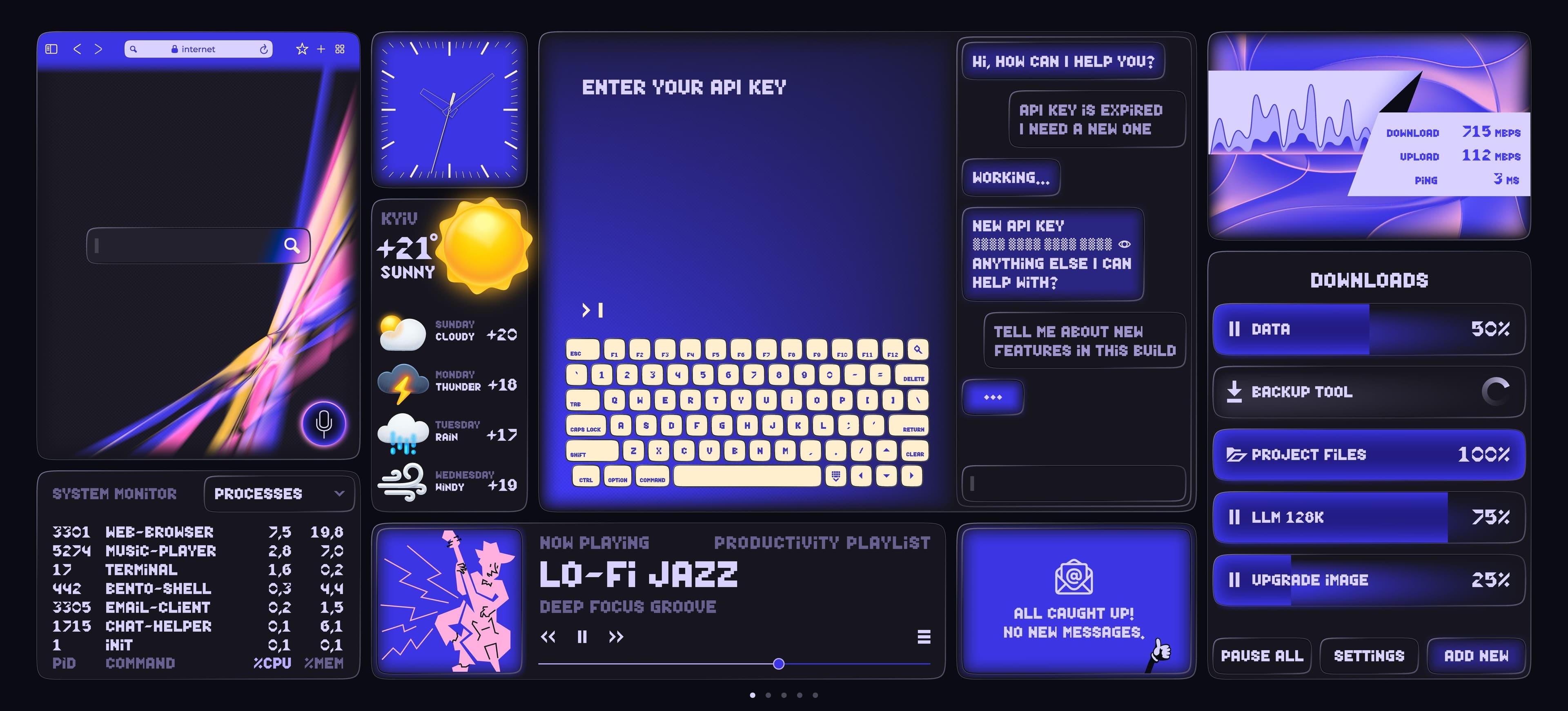
Unlike traditional grids based on regular columns, Bento Grid allows you to combine blocks of different sizes. These blocks can contain text, images, video, or interactive elements, while the whole looks organized and natural. For users, this layout is easy to read and intuitive.
In layman's terms, Bento Grid can be described as a visually structured space where each content element has its place and where it is possible to quickly understand what is important and where to focus.
Structure and working with content
The basic feature of Bento Grid is modularity. Content is divided into separate blocks that can be worked with independently. This allows for easy editing, expansion, and adaptation to different types of screens.
The size of the individual blocks naturally creates a hierarchy of information. The dominant parts attract attention, while the smaller blocks complement the context or serve for navigation. This gives the user an overview without the need for complex orientation in long texts.
This approach is very suitable for responsive design. The layout can be rearranged according to the available space without disrupting the logic of the entire layout or the visual continuity of the product.
Design and creation of the Bento Grid layout
The design of the Bento Grid starts with content, not graphics. First, it is necessary to determine what information the interface should convey and how it relates to each other. Only then are the individual blocks, their sizes, and locations designed.
Visual diversity is controlled, not random. Contrast, varying degrees of detail, and clearly defined boundaries between individual parts are used. The result is an interface that looks modern, yet calm and professional.
From a technical standpoint, Bento Grid integrates well with a component-based approach to development. This facilitates collaboration between designers and developers and promotes the long-term sustainability of the interface.
A shift in thinking about digital design
The spread of Bento Grid has brought about a change in how layouts are approached. The emphasis has shifted from strict regularity to thoughtful flexibility. The goal is no longer to adhere to a precise grid, but to create a structure that respects both the content and the user's behavior.
This way of thinking is particularly prevalent in web presentations, SaaS applications, and product pages, where it is necessary to combine different types of information in one place. Bento Grid allows you to present more complex messages in a clear and visually sophisticated way.
At the same time, it supports long-term work with design. Thanks to its modular layout, the interface can be easily updated without the need for major changes to the entire structure.
Bento Grid in the broader ecosystem of digital work
With the growing amount of digital materials, the demands on their organization are increasing. Bento Grid can be seen as a visual reflection of a systematic approach to content, where each element has a clearly defined place.
A similar logic applies to the management of brand assets. BrandCloud supports clear work with visual materials, versions, and approved outputs. This approach is in line with the philosophy of Bento Grid, where structure and clarity help maintain order and consistency.
Where Bento Grid is headed
Bento Grid is gradually becoming a common part of modern digital design. It appeals not only to designers, but also to content creators, product managers, and brands that want to present their message clearly and elegantly.
Its benefit lies in combining aesthetics, functionality, and long-term sustainability. Users get interfaces that are clear and easy to understand, while creators have a flexible tool for working with content.
At a time when digital products are constantly growing and changing, Bento Grid provides a stable foundation on which to build interfaces that meet current and future expectations.